

















Your lower back has been talking to you. Maybe it’s a dull ache after sitting too long. Maybe it’s that sharp catch when you bend to tie your shoes.
Whatever the signal, you’re here for lower back stretching exercises that actually work.
You’re not alone. Low back pain is the single leading cause of disability worldwide, according to a 2018 study published in The Lancet. Your instinct might be to rest until it passes. That approach usually backfires. Muscles tighten further. Stiffness compounds. The cycle repeats.
The fix is movement. Lower back stretching exercises release the muscles pulling on your lumbar spine and restore the flexibility your body needs to function without pain.
Why Your Lower Back Needs More Than Rest
Most people get a sore lower back and stop moving. Rest feels logical. But inactivity lets the muscles around your spine shorten, stiffen, and weaken, which makes the next flare-up worse. The key to how to relieve lower back tension is targeting the muscles above and below your lumbar spine, not just the lower back itself.
Your lower back rarely works in isolation. Tight hip flexors tilt your pelvis forward, increasing the curve in your lumbar spine.
Short hamstrings pull your pelvis the other direction, flattening that curve and compressing your discs. Stiff glutes limit hip mobility, forcing your lower back to pick up the slack during every bend, twist, and step.
Stretching these muscle groups takes the mechanical stress off your lumbar spine. The tension eases. Range of motion improves. And the pain often fades.
A meta-analysis in the American Journal of Epidemiology found that exercise alone reduces the risk of low back pain episodes by 33%. That’s a powerful number for something that costs nothing and takes 15 minutes.
The stretches below target the muscles responsible for most lower back tension. Some are bodyweight. Some use back gym equipment like a TRX Suspension Trainer™. All of them can be done at home.
Before You Start: Quick Setup Tips
A few ground rules before you get on the floor.
Know the difference between discomfort and pain. A good stretch feels like tension, a gentle pull that you can breathe through.
Sharp, shooting, or burning pain means you’ve gone too far. Back off immediately.
Talk to your doctor if you have an existing back condition. These stretches are intended for general stiffness and tension, not as a substitute for medical treatment.
The bodyweight exercises require no equipment. The TRX variations require a TRX Suspension Trainer anchored at an appropriate height.
Child’s Pose
This one tops the list for a reason. Child’s Pose gently stretches your lower back, lats, and hips while letting gravity do the work. It’s low-effort and surprisingly effective, which makes it a good starting point if your back feels locked up.
People who sit for long hours love this stretch because it opens up the posterior chain in a position that feels safe and supported. Your spine gets to decompress without load.
How to Do It
Kneel on the floor with your big toes touching and your knees spread about hip-width apart.
Sit your hips back toward your heels.
Walk your hands forward along the floor until your arms are fully extended and your forehead rests on the ground (or as close as comfortable).
Let your chest sink toward the floor. Relax your shoulders away from your ears.
Breathe slowly. With each exhale, let your hips settle a little deeper toward your heels.
Hold for 30 to 60 seconds. Repeat 2 to 3 times. If your knees bother you in this position, place a folded towel behind them for padding.
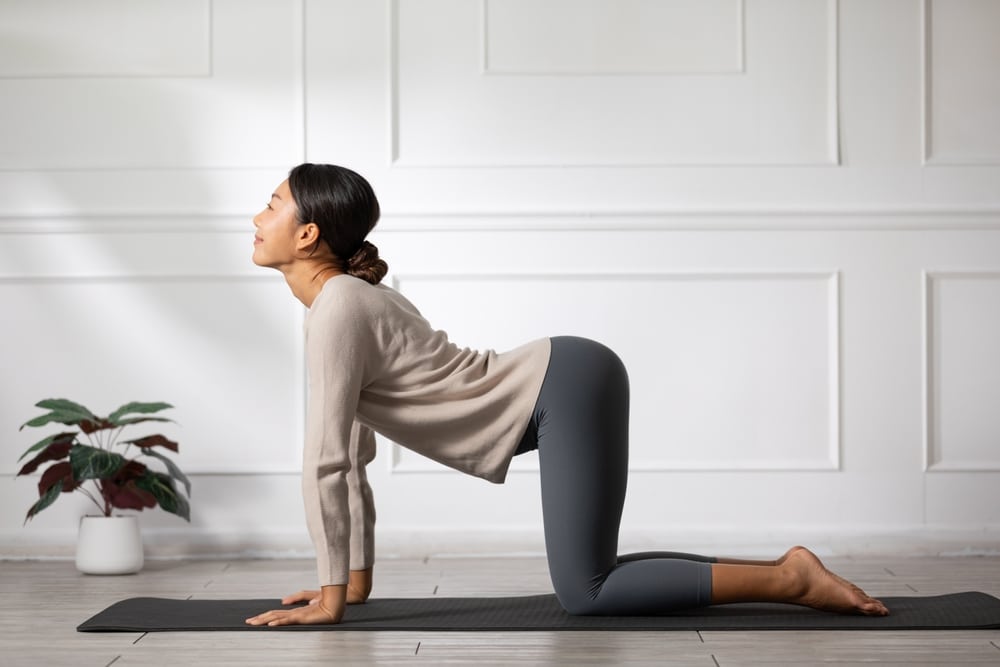
Cat-Cow Stretch
Spinal mobility work disguised as something easy. Cat-Cow moves your spine through flexion and extension in a controlled, rhythmic pattern that warms up every segment of your back. It’s one of the fastest ways to loosen a tight lower back before a workout or after a long day at a desk.
Desk workers, pay attention. This one counteracts the stiffness from sitting in the same position for hours.
Cat-Cow teaches your spine to move again. Not just the lower back, but your entire trunk. That distributed mobility takes pressure off the lumbar vertebrae that bear the brunt of sitting all day.
How to Do It
Start on all fours with your wrists under your shoulders and knees under your hips. Keep your back flat to start.
Inhale as you drop your belly toward the floor. Lift your tailbone and chest toward the ceiling. Let your head follow, looking slightly upward. This is Cow.
Exhale as you round your spine toward the ceiling. Tuck your tailbone, draw your belly button toward your spine, and let your head drop between your arms. This is Cat.
Move slowly between these two positions, matching each transition to your breath.
Perform 10 to 12 cycles. One cycle equals one Cow and one Cat. Focus on making the movement smooth and continuous rather than rushing through reps. Cat-Cow pairs well with other mobility exercises targeting the hips and thoracic spine for a complete warm-up.
Knee-to-Chest Stretch
This stretch targets your lower back and glutes directly. Simple, effective, and you can do it lying in bed if that’s where your back decided to seize up.
Pulling your knee toward your chest flexes the lumbar spine in a controlled way, creating space between the vertebrae. That gentle traction makes this a go-to lower back pain relief stretch when your lumbar spine feels compressed.
Single Leg
Lie on your back with both knees bent and feet flat on the floor.
Bring one knee toward your chest. Clasp your hands around your shin, just below the kneecap.
Gently pull the knee closer until you feel a stretch in your lower back and glute on that side.
Keep your opposite foot flat on the floor and your lower back pressed gently into the ground.
Hold for 20 to 30 seconds, then switch legs.
Both Legs
Bring both knees to your chest at the same time. Wrap your arms around both shins and gently rock side to side to massage the muscles along your lower back.
Repeat 2 to 3 times per side (or 2 to 3 times with both legs).
Supine Spinal Twist
Rotational mobility is one of the most overlooked pieces of lower back health. Your spine is designed to rotate, and when it can’t, the muscles along your sides and lower back lock down to protect the joint. That protective tension becomes the problem over time.
The Supine Spinal Twist addresses this by gently rotating your lumbar and thoracic spine while you’re supported by the floor. Among stretches for lower back pain, rotational movements are often the most overlooked and the most effective at releasing deep tension.
How to Do It
Lie on your back with both arms extended out to your sides in a T position, palms facing down.
Bend both knees and bring your feet flat to the floor.
Let both knees fall slowly to one side, keeping your shoulders pressed into the floor.
Turn your head to look in the opposite direction of your knees.
Let gravity pull your knees toward the floor. Don’t force them down.
Hold for 20 to 30 seconds per side. Repeat twice on each side. The key here is relaxation. If you’re muscling your knees to the floor, you’re missing the point.
Standing Hamstring Stretch
Tight hamstrings are one of the most common hidden contributors to lower back pain. When these muscles shorten (and they do, especially if you sit most of the day), they pull on the bottom of your pelvis. That tilt changes the alignment of your lumbar spine, and your lower back pays the price.
You can stretch your hamstrings lying down, but the standing version lets you control the intensity more precisely.
How to Do It
Find a low step, bench, or sturdy surface about knee height.
Place one heel on the surface with your leg straight and toes pointing up.
Stand tall. Keep your hips square, both facing forward.
Hinge at your hips and lean your torso forward slightly until you feel a stretch along the back of your raised leg.
Keep your back flat throughout the movement. Rounding your spine shifts the stretch away from your hamstring.
Hold for 20 to 30 seconds per leg. Repeat twice on each side. You don’t need to fold yourself in half. A small forward lean is enough if your hamstrings are particularly tight. Beyond stretching, hamstring exercises at home like glute bridges and single-leg deadlifts strengthen these muscles to prevent future tightness.
TRX Suspension Trainer Lower Back Stretches
The bodyweight stretches above give you a solid foundation for low back flexibility. A TRX Suspension Trainer goes further, adding gravity-assisted decompression and adjustable resistance for deeper stretches with more control.
Anchoring yourself to the straps lets you lean into positions that would be difficult or impossible to hold freestanding. You control how deep you go by adjusting your foot position and body angle.
TRX Low Back Stretch (Standing Lean-Away)
This is the TRX stretch most people feel immediately. Holding the handles and leaning your weight back lets gravity gently decompress your lumbar spine while you round through your lower back. It targets the same area as Child’s Pose but from a standing position, with greater control over the intensity.
How to Do It
Stand facing the TRX anchor point. Grip both handles with arms extended in front of you.
Walk your feet forward until the straps are taut and your arms are fully extended.
Sit your hips back and lean your weight away from the anchor point.
Round your upper and lower back, letting your head drop between your arms. Think about pushing your spine toward the wall behind you.
Breathe deeply. With each exhale, allow yourself to sink a little deeper into the stretch.
Hold for 20 to 30 seconds. Repeat 2 to 3 times. Adjust intensity by stepping your feet closer to (easier) or farther from (deeper) the anchor point. Pair this stretch with TRX back exercises like rows to build the posterior chain strength that keeps your lower back pain-free.
TRX Hip Drop Stretch
If your lower back pain tends to show up more on one side, this stretch is built for that. The TRX Hip Drop targets the lateral hip and the quadratus lumborum, a deep muscle that connects your pelvis to your lowest rib. Stiffness in this area often contributes to sacroiliac (SI) joint discomfort and one-sided lower back tension.
How to Do It
Stand sideways to the TRX anchor point. Grip both handles with the hand closest to the anchor.
Step your feet together and extend your free arm overhead or out to the side for balance.
Push your hips away from the anchor point, letting the straps support your weight as you create a C-curve with your torso.
You should feel a stretch along the side of your hip and lower back.
Hold for 15 to 20 seconds per side. Repeat twice. This is a subtle stretch. Small adjustments in hip position change where you feel it, so experiment with your stance. Other TRX hip exercises like standing hip flexor stretches and adductor drops address stiffness from additional angles.
TRX Hamstring Stretch
Using the straps for balance lets you get deeper into a hamstring stretch than the standing version. No need to worry about tipping over or compensating with poor form.
How to Do It
Stand facing the TRX anchor point. Hold both handles at hip height with arms extended.
Extend one leg straight out in front of you, resting the heel on the ground with toes pointed up.
Hinge at your hips and lean your torso forward, using the straps for balance and support.
Keep your back flat and your chest lifted throughout the stretch.
Hold for 20 to 30 seconds per leg. Repeat twice on each side. The straps let you hold this position longer and more comfortably than the unassisted version, which means a more effective stretch. For dynamic hamstring work, the TRX hamstring curl builds strength through the same range of motion.
How to Build a Lower Back Stretching Routine
Knowing individual stretches is useful. Doing them consistently is what actually changes how your back feels.
Pick 4 to 5 stretches from the list above. You don’t need to do all of them in one session. Rotate exercises across the week to keep things varied and address different muscle groups.
Do your routine 2 to 3 times per week. Consistency matters more than duration. Fifteen minutes, three times a week beats an hour-long session once a month. Your lower back flexibility will improve noticeably within the first two to three weeks.
If you’re new to stretching, start with the bodyweight exercises only. Child’s Pose, Cat-Cow, Knee-to-Chest, and one twist or hamstring stretch make a solid beginner routine. Give yourself two to three weeks to build the habit before adding anything.
- Once the bodyweight stretches feel easy, add the TRX exercises. The TRX Suspension Trainer lets you progress the same movement patterns by adjusting angle and load. That progressive approach builds long-term flexibility rather than temporary relief.
For hip stretches, TRX Exercise Bands can add gentle resistance that strengthens the muscles in their lengthened position. That combination of stretching and light strengthening is what keeps your lower back feeling good between sessions.
Start Moving, Stop Waiting
Your lower back won’t fix itself on the couch. These lower back stretching exercises take 10 to 15 minutes and require nothing more than floor space. The TRX variations let you go deeper as flexibility improves. Use them at home, in the gym, or on the road. A suspension trainer, a mat, and a few bands are all the home gym equipment your lower back routine needs.
Pick a few stretches. Do them this week. Notice how your back responds. Then build from there. The TRX Suspension Trainer makes the progression smooth, but the most important step is the first one you actually take.
References
Hartvigsen, Jan, et al. “What Low Back Pain Is and Why We Need to Pay Attention.” The Lancet, vol. 391, no. 10137, 2018, pp. 2356-2367.
Shiri, Rahman, et al. “Exercise for the Prevention of Low Back Pain: Systematic Review and Meta-Analysis of Controlled Trials.” American Journal of Epidemiology, vol. 187, no. 5, 2018, pp. 1093-1101.