
















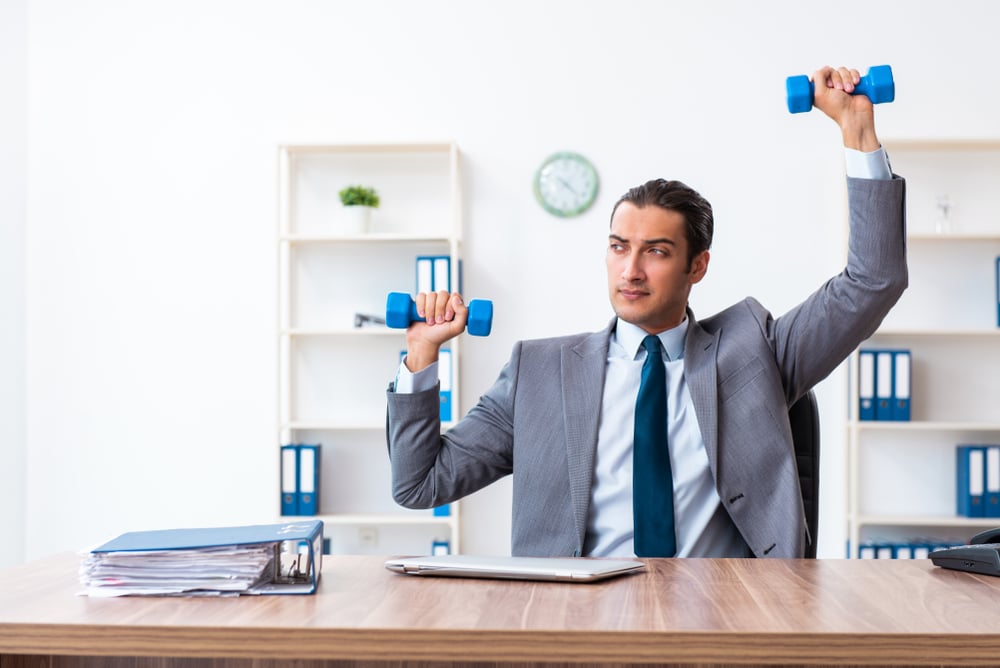
Imagine it is 3:00 PM. Your lower back feels compressed, your shoulders are creeping toward your ears, and your neck has been locked in a forward tilt since your first morning meeting. Humans were not designed to remain folded into a seated position for eight hours a day. That mid-afternoon mental fog is often just your body’s way of protesting a lack of movement.
This guide provides a practical solution to sedentary work habits. We have curated 20 highly effective exercises for desk workers, categorized into two distinct phases. The first section features 10 movements you can perform discreetly at your desk in professional attire. The second section outlines 10 dynamic office workouts designed for when you can step away for a 10-minute break, utilizing body weight or a TRX Suspension Trainer™ for maximum efficiency.
The Vital Importance of Movement for Office Professionals
For those who spend most of their day at a desk, frequent movement breaks are a necessity, not a luxury. Prolonged sitting is known to shorten hip flexors, deactivate the glutes and core, and cause stiffness in the thoracic spine. Beyond physical discomfort, a lack of movement slows circulation and can lead to a significant drop in cognitive focus. By incorporating brief exercise intervals every 30 to 60 minutes, you can mitigate these issues and safeguard your long-term joint health.
Research from institutions like the Mayo Clinic suggests that uninterrupted sitting is associated with increased risks of metabolic and cardiovascular concerns. However, the data also shows that interrupting these sedentary periods with even short bursts of activity can significantly offset these risks. The goal of these movements is simple: move more effectively to enhance your productivity and long-term well-being.
Evaluate Your Current Fitness Level
Integrating These Exercises Into Your Daily Routine
The following guide is organized into two parts to suit your environment. Part 1 focuses on mobility and light strength work that requires no equipment and can be done entirely from your chair. These are quiet, low-impact moves that won’t disrupt your office environment. Part 2 introduces more vigorous movements that utilize a small amount of floor space or a TRX Suspension Trainer anchored to a door.
To stay consistent, you might follow the “5-5-5-30” strategy: for every 30 minutes of seated work, stand for five minutes, perform five repetitions of a strength movement, and take five intentional paces. This creates a natural rhythm that prevents your body from stiffening up.
Note: If you have pre-existing injuries or chronic health conditions, it is always advisable to consult with a medical professional before starting a new exercise regimen.
Desk-Friendly Mobility: 10 Exercises You Can Do in Your Chair
These initial 10 movements are designed to be performed in standard office clothing without any special equipment. We begin with mobility and stretching to address the common postural collapses caused by screen time, followed by light isometric work to keep your muscles engaged.
1. Neck Stretches and Mobility Rotations
“Tech neck” is a common result of monitor-focused work, where the head is pulled forward, straining the trapezius muscles. Regularly resetting your neck’s range of motion can alleviate tension headaches and upper back pain.
- Maintain a tall posture in your chair and relax your shoulders.
- Gently tilt your right ear toward your right shoulder, holding for 15 seconds.
- Switch to the left side and repeat the hold.
- Tuck your chin toward your chest to stretch the back of the neck for 15 seconds.
- Slowly roll your head in a semi-circle from side to side. Avoid rolling your head backward, which can compress the cervical spine.
Keep your shoulders depressed throughout the movement; do not allow them to hunch up toward your ears. Focus on deep, rhythmic breathing.
2. Controlled Shoulder Rolls and Tension Release
Stress and concentration often cause us to unconsciously shrug our shoulders. This tension builds up throughout the day, leading to stiffness. Intentional rolls help signal the nervous system to relax these overactive muscles.
- Sit upright with your arms hanging naturally at your sides.
- Rotate your shoulders backward in large, slow circles for 10 repetitions.
- Reverse the direction and rotate forward for 10 repetitions.
- Finish with 10 deliberate shrugs: lift your shoulders to your ears, hold for two seconds, and drop them completely.
Visualize your spine growing taller with each rep. The “drop” phase of the shrug should feel like a total release of physical stress.
3. Seated Torso Rotations
Spinal rotation is often the first range of motion lost to a sedentary lifestyle. Since desk work keeps the spine in a fixed, forward-facing position, a gentle twist can help restore thoracic mobility and alleviate mid-back tightness.
- Keep your feet flat on the floor and sit tall.
- Reach your right hand to your left knee and place your left hand on the back of your chair for support.
- Exhale as you gently twist your torso to the left.
- Hold the position for 20 seconds, focusing on lengthening the spine.
- Return to center and repeat on the opposite side.
Initiate the twist from your mid-back rather than pulling with your neck. The goal is a gentle release, not a forced stretch.
4. Seated Figure-4 Hip Stretch
Hours of sitting cause the hip flexors and glutes to tighten, which is a leading contributor to lower back discomfort. The figure-4 stretch is a discreet way to open the hips while remaining seated.
- Sit near the front edge of your chair.
- Cross your right ankle over your left knee, creating a “4” shape with your legs.
- Maintain a flat back and a long spine.
- Hinge forward at the hips until you feel a stretch in your outer hip and glute.
- Hold for 30 seconds before switching legs.
Avoid rounding your spine to get lower; the movement should come entirely from the hip hinge to be effective.
5. Isometric Glute Activations
When you sit for long periods, your glutes can experience “dormancy” because they are in a relaxed, lengthened state. Isometric contractions wake these muscles up, making it easier for them to support you when you eventually stand.
- While seated, sit as tall as possible.
- Squeeze your glutes together with maximum effort for 5 seconds.
- Relax for a moment.
- Complete 15 to 20 repetitions.
Ensure the tension stays in your glutes rather than your lower back. This is an “invisible” exercise you can perform during meetings or phone calls.
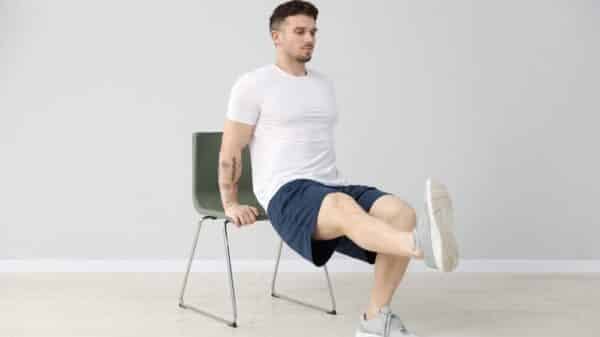
6. Seated Quad Extensions
This movement targets the quadriceps and encourages blood flow through the lower extremities. It is a simple way to maintain muscle tone and circulation without leaving your desk.
- Sit back in your chair so your thighs are supported.
- Slowly straighten your right leg until it is horizontal and parallel to the floor.
- Flex your quad and hold for 5 seconds.
- Lower the leg with control.
- Alternate legs for 10 to 15 reps per side.
Focus on a slow, steady tempo rather than kicking the leg out quickly. Pull your toes toward your shin at the top of the movement.
7. Chair-Based Squat Patterns
The squat is a fundamental human movement that counters the negative effects of sitting. By practicing the “sit-to-stand” motion, you reinforce the mechanics needed for mobility and independence.
- Stand just in front of your chair with feet hip-width apart.
- Send your hips back as if you are going to sit down, keeping your chest elevated.
- Lightly tap your glutes to the seat without fully sitting.
- Drive through your heels to return to a standing position.
- Perform 10 to 15 repetitions.
Ensure your knees stay aligned with your toes and do not collapse inward. Full extension at the top is key to engaging the glutes.
8. Incline Desk Push-Ups
Standard office work involves a lot of reaching forward but very little “pushing” strength. Using the edge of a sturdy desk allows you to perform push-ups at an incline, which is an excellent way to engage the chest, shoulders, and core.
- Place your hands on a stable desk edge, slightly wider than shoulder-width.
- Step your feet back until your body forms a straight line.
- Lower your chest toward the desk with control.
- Press back up to the starting position.
- Repeat for 8 to 12 reps.
Keep your elbows tucked at a 45-degree angle rather than flared out. Safety Tip: Ensure your desk is heavy and stable enough that it will not slide during the movement.
9. Standing Heel Raises
Sitting allows blood to pool in the lower legs. Calf raises act as a “pump” to move blood back toward the heart, reducing swelling and fatigue in the feet.
- Stand behind your chair, using the backrest for balance.
- Slowly rise onto the balls of your feet as high as possible.
- Hold the peak contraction for one second.
- Lower your heels back to the floor with control.
- Perform 15 to 20 repetitions.
Avoid bouncing; the benefit comes from the controlled contraction at the top and the slow descent.
10. Tricep Dips on a Stable Surface
This exercise targets the back of the arms and encourages you to open your chest, reversing the rounded-shoulder posture common in desk work.
- Sit on the edge of a non-rolling, sturdy desk or chair.
- Place your hands next to your hips and grip the edge.
- Step your feet out and slide your hips off the surface.
- Lower your body by bending your elbows to 90 degrees.
- Push back up to the start.
- Complete 8 to 12 reps.
Keep your back close to the desk edge and ensure your shoulders remain down and away from your ears.
Active Office Training: 10 Movements for Improved Strength and Posture
When you have access to a private office, a conference room, or a hallway, these 10 exercises provide a more robust workout. Five of these utilize the TRX Suspension Trainer, a portable tool that is perfect for office environments because it anchors easily to any sturdy door.
11. Air Squats
This is the gold standard for lower-body conditioning. Performing air squats during a lunch break re-engages the large muscle groups of the legs and boosts your metabolic rate.
- Stand with feet shoulder-width apart.
- Lower your hips until your thighs are parallel to the ground.
- Keep your weight in your heels and your chest up.
- Drive back up to a standing position.
- Aim for 12 to 15 controlled reps.
12. Forward Walking Lunges
Lunges challenge your balance and develop single-leg strength, which is vital for real-world activities like climbing stairs or walking long distances. They are a perfect “hallway” exercise.
- Step forward with one leg, lowering your hips until both knees are bent at 90 degrees.
- Ensure your front knee stays above the ankle.
- Push off the front foot to step directly into the next lunge with the opposite leg.
- Complete 10 reps per leg.
13. TRX Mid-Row
The TRX Row is perhaps the most important exercise for desk workers. It specifically targets the muscles between the shoulder blades, directly counteracting the “hunched” posture caused by computer use.
- Anchor the TRX to a closed door and face the anchor point.
- Lean back with arms extended, keeping your body in a rigid plank.
- Pull your chest toward the handles by squeezing your shoulder blades together.
- Lower back down with control.
- Perform 10 to 12 reps.
14. TRX Chest Press
The chest press provides a stable way to build upper-body strength and core stability. It serves as a balanced counterpart to the row.
- Face away from the anchor point with the TRX handles in front of you.
- Lean forward into a plank position.
- Lower your chest toward the handles, then press back to full extension.
- Adjust the difficulty by moving your feet further from or closer to the door.
- Perform 10 to 12 reps.
15. TRX Assisted Squats
Using the TRX for squats allows you to sit deeper into the movement than you might be able to otherwise. It provides balance support, allowing you to focus on proper hip and ankle mechanics.
- Hold the handles with light tension and your arms slightly bent.
- Squat down, using the straps to stay upright and stable.
- Drive through the heels to stand.
- Complete 12 to 15 reps.
16. TRX Single-Leg Lunge
By placing one foot in the TRX cradle, you create an unstable environment that forces your core and stabilizing muscles to work much harder than a standard lunge.
- Place one foot in the foot cradle behind you and stand on the other leg.
- Lower into a lunge, keeping your front knee stable.
- Drive back up to the start.
- Perform 8 to 10 reps per leg.
17. TRX Bicep Curls
This move focuses on arm strength while requiring a high degree of core engagement to maintain a plank position. It provides a great finishing “pump” to an office workout.
- Face the anchor, palms up, holding the handles.
- Lean back into a plank.
- Curl your hands toward your forehead, keeping your elbows high and stationary.
- Extend with control and repeat for 10 to 12 reps.
18. Wall Sit Endurance Hold
The wall sit requires no equipment and very little space. It builds isometric strength and mental focus, acting as a great “reset” for the lower body.
- Lean your back against a flat wall and slide down until your knees are at a 90-degree angle.
- Ensure your back is flat against the wall and your feet are firmly planted.
- Hold the position for 30 to 60 seconds.
19. Dynamic Plank Transitions
This movement combines a core-stabilizing plank with the upper-body engagement of a push-up. It is a highly efficient way to work multiple muscle groups simultaneously.
- Start in a forearm plank position on the floor.
- One hand at a time, press up into a high plank (push-up position).
- Lower back down to your forearms one arm at a time.
- Keep your hips as level as possible throughout the movement.
- Complete 10 total transitions.
20. Aerobic Jumping Jacks
To finish your session, a quick burst of cardio can help clear mental fog and improve circulation. If you need a quieter option, simply step one foot out to the side at a time rather than jumping.
- Perform standard jumping jacks for 60 seconds.
- Focus on light landings and full range of motion with your arms.
Strategies for Scheduling Physical Activity During Work Hours
To successfully integrate these movements, consider these two templates:
The Desk Refresh: Every hour, select two movements from Part 1. This takes roughly 90 seconds and prevents the physical “stagnation” that occurs during long work blocks.
The 12-Minute Express: During your lunch break, choose five exercises from Part 2. Perform each for 40 seconds with 20 seconds of rest. Complete two rounds for a total-body workout that leaves you energized for the afternoon.
The TRX system is particularly well-suited for the office because of its origins. It was developed by a Navy SEAL who needed a way to stay fit in confined spaces with limited time. That same efficiency applies to the modern professional who wants to maintain their health without spending hours in a gym.
Common Questions About Workplace Fitness
What is the 3-3-3 rule for working?
The 3-3-3 rule is a time-management strategy where you dedicate three hours to deep, focused work, complete three urgent smaller tasks, and finish three maintenance tasks. Movement breaks are best scheduled between these “threes” to refresh your focus.
How do you exercise while working a desk job?
The most effective way is to use “exercise snacking”—short, frequent bursts of activity throughout the day. By utilizing the 5-5-5-30 rule (5 minutes standing, 5 reps, 5 paces every 30 minutes), you can accumulate significant activity levels without disrupting your workflow.
What is the 5 5 5 30 rule?
This rule is a simple cue to break up sedentary behavior: every 30 minutes of sitting should be followed by standing for 5 minutes, performing 5 repetitions of a movement (like a squat or stretch), and taking 5 intentional steps or paces.
What is the best exercise for office workers?
While variety is important, the TRX Row is often considered the most beneficial single exercise for office workers because it directly targets and corrects the postural imbalances caused by sitting and typing.
Final Thoughts on Workplace Wellness
Improving your health at work does not require a gym membership or a massive time commitment. By starting with just a few stretches from Part 1 tomorrow, you can begin to reverse the negative effects of a sedentary lifestyle. For those ready to take it further, the TRX Suspension Trainer offers a professional-grade workout that fits in a desk drawer and anchors to any door in seconds. By prioritizing these small movement windows, you can build a stronger, more resilient body while excelling in your career.