




















If you finish a leg day only to find that your lower back feels more exhausted than your quads, your body is sending a clear signal: your core is the weak link in your kinetic chain. This common issue indicates that your stabilizing muscles aren’t yet strong enough to support your heavier lifts. Fortunately, foundational core training can address this imbalance at home using just a yoga mat and about twenty minutes of your time.
This guide explores seven essential core exercises designed specifically for beginners. We will cover proper form to prevent injury and provide a structured routine to follow. While the first five movements require no equipment, the final two introduce the TRX Suspension Trainer™—an ideal progression for those ready to add a challenge. As with any new fitness regimen, consult with a healthcare professional before starting, particularly if you have a history of back discomfort.
Effective Core Strengthening Strategies for Novices
The roadmap for a beginner is straightforward: select five to seven movements that challenge the midsection from various angles. Start with static holds to build endurance before moving toward dynamic actions. Aim for two to three sessions per week, focusing on increasing time or stability rather than adding heavy weights right away.
In the following sections, we will break down a curriculum that includes:
Defining the Core: More Than Just Visible Abs
Many people mistake the “core” for the “six-pack” muscles, but it is a complex 360-degree system. It includes the deep transverse abdominis, the internal and external obliques, the erector spinae along the spine, and the stabilizers around the hips and pelvis. These muscles function as a cohesive unit to keep your spine safe while your limbs move.
For a beginner, understanding that the core’s primary role is resisting movement—rather than creating it—is vital. Research by spinal biomechanics experts, such as Dr. Stuart McGill, suggests that training the core to maintain stability against external forces leads to better athletic performance and a lower risk of injury. By teaching your core to stay rigid during real-world tasks, you improve your posture and functional strength.
Essential Equipment for Home Core Training
You don’t need a gym full of machines to build a resilient midsection. For the foundational movements, a comfortable floor surface or a yoga mat is sufficient. Wear clothes that allow for a full range of motion and keep water nearby.
As you progress, the TRX Suspension Trainer becomes a valuable asset. Originally developed by a Navy SEAL using parachute webbing, this portable tool leverages gravity and your body weight to create instability. It can be anchored to a door, a sturdy beam, or even a tree branch. However, if you don’t have one yet, the bodyweight exercises provided here offer a perfect starting point.
Safety reminder: If you are recovering from surgery or managing a chronic hip or back condition, seek medical clearance before attempting these exercises.
7 Fundamental Core Exercises for Your Home Routine
The sequence of these exercises is intentional. We begin with movements that teach you how to engage your muscles properly, then progress to dynamic shifts and, finally, instability-based challenges. Focus on mastering the mechanics of each move before worrying about high repetitions.
1. The Dead Bug
This exercise trains your core to remain stable while your arms and legs move independently—a skill used every time you walk or run. It is often cited as a top choice for spinal health because the floor provides feedback and support for your lower back.
Instructions:
- Lie flat on your back, raising your arms toward the ceiling and bending your knees to 90 degrees (tabletop position).
- Press your lower spine into the mat and brace your abdominals.
- Slowly lower the opposite arm and leg toward the floor, keeping them straight.
- Pause just above the ground, then return to the start and switch sides.
- Aim for 8 to 10 repetitions per side.
Form Tip: Ensure your ribs stay tucked. If your lower back arches off the floor, you’ve lowered your leg too far. Reduce the range of motion until you can maintain a flat back.
2. The Bird Dog
The Bird Dog is essentially a “Dead Bug” flipped over. It emphasizes anti-rotation, teaching you to stay level even when weight shifts. This builds the stability needed for tasks like lifting heavy objects or maintaining balance.
Instructions:
- Start on all fours with hands under shoulders and knees under hips.
- Maintain a straight, neutral spine.
- Simultaneously reach one arm forward and the opposite leg back until they are parallel to the floor.
- Hold for two seconds, focusing on keeping your hips square to the ground.
- Return to center and alternate. Perform 6 to 10 repetitions per side.
Form Tip: Keep your gaze on the floor to maintain a neutral neck. Avoid letting your hips tilt or your back sag as you extend.
3. The Glute Bridge
While often categorized as a leg exercise, the glute bridge is vital for core stability. It connects the power of the glutes to the stability of the spine, helping to keep the pelvis in a neutral position.
Instructions:
- Lie on your back with knees bent and feet flat, hip-width apart.
- Drive through your heels to lift your hips toward the ceiling.
- At the top, squeeze your glutes so your body forms a straight line from knees to shoulders.
- Lower slowly and repeat for 10 to 12 repetitions.
Form Tip: Do not over-arch your lower back at the top. The movement should come from the hips and glutes, not the spine.
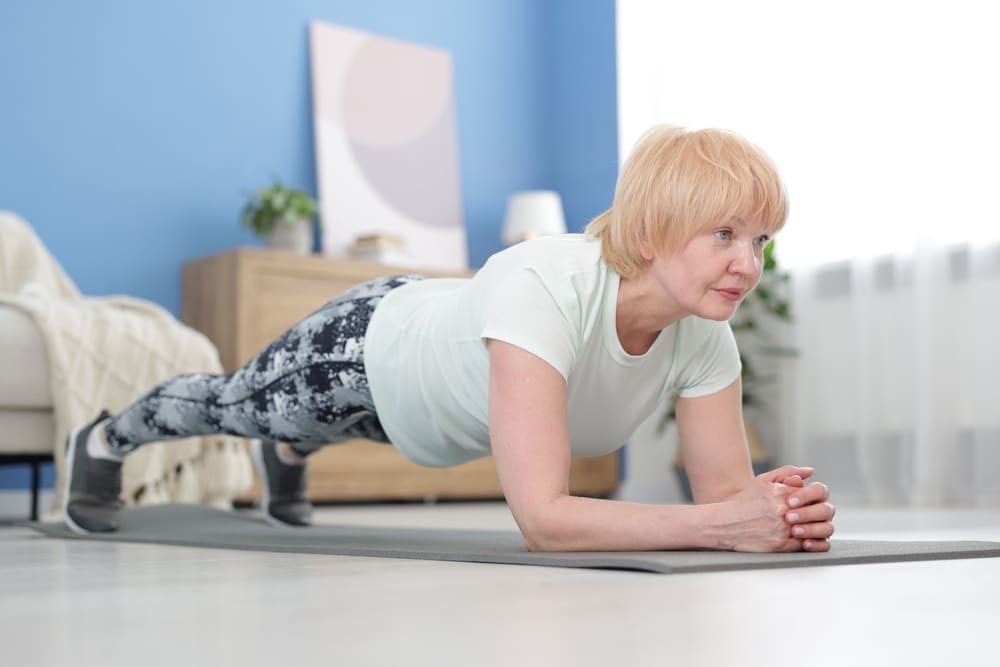
4. Forearm Plank
The plank is a classic for a reason: it builds total-body tension. However, many beginners prioritize duration over quality. A shorter, “active” plank is significantly more effective than a long, sagging hold.
Instructions:
- Rest on your forearms with elbows directly under your shoulders.
- Step your feet back, creating a straight line from your head to your heels.
- Contract your glutes and brace your core as if preparing for a literal impact.
- Hold for 20 to 30 seconds. Complete 3 sets.
Form Tip: Avoid letting your hips drop or your butt pike into the air. Look at the space between your hands to keep your neck aligned.
5. Side Plank
Traditional planks focus on the front, but the side plank targets the obliques and lateral stabilizers. Neglecting these side muscles is a common cause of unexpected back strain during lateral movements.
Instructions:
- Lie on your side, propped up on your bottom forearm.
- Stack your feet (or stagger them for better balance).
- Lift your hips until your body is in a straight diagonal line.
- Hold for 20 to 30 seconds, then switch sides.
Form Tip: Keep your chest open and don’t let your hips rotate forward or dip. If the full version is too difficult, perform the move with your knees bent at 90 degrees.
6. TRX Suspension Plank
By placing your feet in the TRX foot cradles, you introduce instability. This forces the deep stabilizing muscles of the spine to work harder to keep you level, providing a significant upgrade to the standard floor plank.
Instructions:
- Adjust the straps to mid-calf height.
- Place your toes in the cradles while facing down and rest on your forearms.
- Lift your knees to enter the plank position.
- Maintain a rigid core and glute contraction for 15 to 30 seconds.
Form Tip: Get your feet settled before lifting your weight. Focus on steady breathing to maintain the tension in your abdominals.
7. TRX Standing Roll-Out
The roll-out is a high-level core exercise that many struggle with on the floor. Using the TRX allows you to adjust the difficulty by changing your foot position—making it accessible for everyone.
Instructions:
- Face away from the anchor point, holding the handles at chest height.
- Lean forward slightly into the straps.
- Keep your arms straight and slowly raise them overhead, allowing your body to tilt further forward.
- Once you feel a strong core engagement, pull your arms back down to the start.
- Perform 6 to 8 repetitions.
Form Tip: Start with a very small range of motion. The goal is to prevent your back from arching. If your hips sag, you’ve gone too far.
A Complete Core Training Plan for Beginners
Use the following structure for a comprehensive at-home session. Perform three full rounds of the circuit:
- Dead Bug: 8–10 reps per side
- Bird Dog: 6–10 reps per side
- Glute Bridge: 10–12 reps
- Forearm Plank: 20–30 seconds
- Side Plank: 20–30 seconds per side
- TRX Plank: 15–30 seconds (Introduce in week 2)
- TRX Standing Roll-Out: 6–8 reps (Introduce in week 2)
Allow for 30 to 45 seconds of rest between moves and a full minute between rounds. Aim for two to three sessions weekly. Focus on the quality of every movement to ensure long-term progress.
How to Safely Advance Your Training
Once the basic movements feel manageable, you can continue to see results by pulling these four “levers” of progression:
- Time Under Tension: Gradually increase hold times for planks (e.g., adding 5 seconds each week) until you can perform a perfect 60-second hold.
- Increase Volume: Add an extra round to your workout to build endurance.
- Introduce Instability: Transition from floor-based moves to the TRX trainer to recruit more muscle fibers.
- Add External Load: Once your form is flawless, you can introduce weights like a vest or kettlebell for dynamic movements like the glute bridge.
Professional Insights for Better Core Results
To get the most out of your training, keep these expert tips in mind:
- Master the Brace: Don’t hold your breath. Learn to tighten your midsection while exhaling slowly. This “bracing” provides stability without causing unnecessary internal pressure.
- Maintain a Neutral Spine: Avoid flattening your back completely or arching it excessively. Find the natural curve of your spine and hold it there during every rep.
- Prioritize Form Over Clock: A short plank with perfect alignment is vastly superior to a long plank where your hips are sagging. End the set when your form starts to slip.
- Move in All Directions: A complete program must address the front, the sides, and rotational stability. If you only do crunches, you are leaving your back vulnerable.
Common Questions Regarding Beginner Core Training
How can a total beginner start core training?
Focus on five to seven foundational movements like the Dead Bug and Plank. Start with static holds to build a “base” of strength before moving on to complex or weighted exercises. Consistency—roughly three times a week—is key.
What are the “Big 3” core exercises?
Renowned expert Dr. Stuart McGill identified the Bird Dog, Side Plank, and Curl-Up as the “Big 3.” These are favored because they maximize core activation while minimizing the stress placed on the spinal discs.
How should core training change for those over 50?
The goals remain the same, but the methods should prioritize spinal safety. Avoiding high-repetition sit-ups and focusing instead on stability moves like the Bird Dog and Glute Bridge can help protect the lower back and neck while building functional strength.
Is daily core training necessary?
No. Like any other muscle group, the core needs time to recover and rebuild. Training two to three times a week with rest days in between is the most effective way to build genuine strength without risk of overuse injury.
Conclusion: Building a Foundation for Life
Investing fifteen to twenty minutes a few times a week into a core-specific routine pays dividends in every other aspect of your life. Whether you are squatting in the gym, running on the trail, or simply sitting at a desk, a stable midsection protects your spine and improves your overall movement quality. Start with the bodyweight foundations, and as you get stronger, use tools like the TRX Suspension Trainer to keep challenging your limits. By focusing on consistency and proper form, you will develop the resilient core needed to move better, feel stronger, and stay active for years to come.