



















Looking to develop stronger, more sculpted triceps without relying on heavy gym machinery? Resistance bands offer a unique advantage through linear variable resistance. As the band stretches, the tension increases, meaning your muscles work hardest at the point of peak contraction—the lockout—where the triceps are naturally most active.
By utilizing specific band movements, you can target all three components of the muscle: the long, lateral, and medial heads. This comprehensive approach ensures balanced development, improved lockout power, and the ability to maintain constant tension regardless of your training location. If you are ready to enhance your upper body routine, here are ten effective banded exercises to implement today.
The Top 10 Resistance Band Exercises for Tricep Development
These exercises are designed to improve muscle definition while building functional strength. They are accessible for fitness enthusiasts of all levels and work exceptionally well with high-quality strength bands.
1. Standing Overhead Extensions
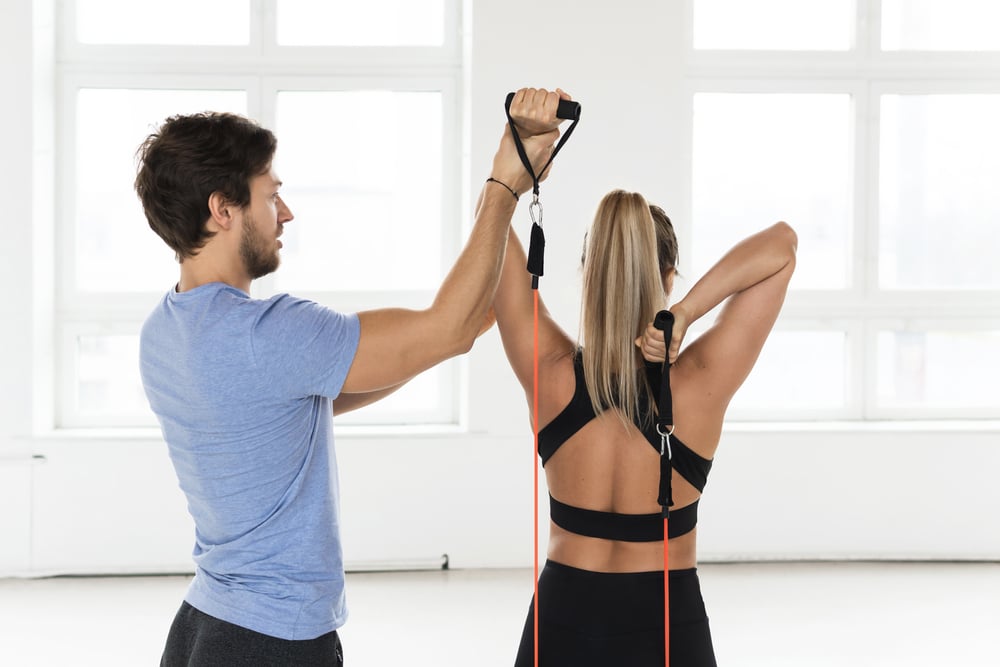
To perform this move, secure the center of the band under your feet and grip the handles behind your neck. Maintain an upright posture with your core engaged and elbows pointing toward the ceiling. Extend your arms upward until they are straight, then lower them slowly back to the starting position. While this move primarily targets the long head of the tricep, all three heads are recruited to complete the extension.
2. High-Anchor Banded Pushdowns
Attach your band to a high anchor point, such as a sturdy hook or over a door frame. Face the anchor and grasp the band, stepping back to ensure there is tension from the start. Keeping your elbows pinned to your ribs, press the band down until your arms are fully extended. For an extra peak contraction, slightly rotate your palms toward the floor at the bottom of the movement. Control the ascent to maximize time under tension.
3. Banded Kickbacks
Adopt a staggered stance and hinge at the hips until your torso is at a 45-degree angle. Hold the band with one hand, keeping the upper arm parallel to your torso and the elbow bent at 90 degrees. Extend your arm backward until it is straight, then return slowly. Avoid using momentum or swinging the shoulder; the focus should remain entirely on the tricep muscle.
4. Resisted Close-Grip Push-Ups
Wrap the band across your upper back, securing the ends beneath your palms. Place your hands shoulder-width apart or slightly narrower. As you push away from the floor, the band provides increasing resistance at the top of the movement, challenging your triceps during the lockout. To adjust the difficulty, you can drop to your knees or use a thicker band for greater tension.
5. Cross-Body Pressdowns
Secure the band to a high anchor and stand perpendicular to it. Reach across your body with the far hand to grab the band. Starting with the elbow bent near your chest, press your hand down and across toward the opposite hip. This specific angle emphasizes the long head of the tricep by incorporating a slight degree of shoulder adduction during the extension.
6. Kneeling Concentration Pressdowns
Anchor the band low and take a kneeling position. Grasp the handle with an underhand grip and brace your elbow against the inner part of your thigh for stability. Press the hand down until the arm is fully straight. By locking the elbow against the leg, you eliminate momentum, creating a strict isolation movement that forces the triceps to do all the work.
7. Unilateral Overhead Extensions
Step on the band and bring one handle up behind your head. Similar to the two-arm version, keep your elbow high and extend your arm fully toward the ceiling. Training one arm at a time allows you to focus on muscle symmetry and address strength imbalances. Always start with your weaker side and match the volume with your stronger arm.
8. Lying Banded Skull Crushers
Lie on your back on the floor or a weight bench with the band anchored behind your head. Hold the handles with your arms extended over your chest. Bend only at the elbows to lower the handles toward your forehead, then drive them back up. Keeping your upper arms angled slightly backward throughout the set maintains constant tension on the tricep tendons and muscle fibers.
9. Reverse-Grip Banded Pushdowns
Using a high anchor point, grasp the band with an underhand (palms up) grip. Keep your elbows tucked in and press down until your arms reach full extension. This grip variation shifts the emphasis and can also engage the forearms, which is beneficial for overall grip strength. Ensure your elbows do not drift forward during the set.
10. Tricep Pull-Aparts
Hold the band at chest height with arms extended straight in front of you, hands shoulder-width apart. Using your triceps, pull your hands apart toward your sides while keeping your arms straight. Focus on the hard contraction of the triceps at the wide point of the move. This is an excellent high-rep finisher to maximize blood flow and muscular endurance.
Choosing the Right Resistance Band for Your Training
The effectiveness of your workout depends on selecting the right tool for the job. Consider these common options:
- Loop Bands: Simple and versatile for various anchoring methods, though they can occasionally roll during use.
- Handle Bands: These provide a grip similar to cable machines, making them ideal for heavy pushdowns and overhead work.
- Flat Therapy Bands: These are excellent for high-repetition sets, mobility work, or rehabilitation, offering a gentle but effective tension.
Resistance bands are typically color-coded by tension levels ranging from light to heavy. For isolation movements like kickbacks, a lighter band is preferable to maintain proper form. For compound movements like banded push-ups, a heavier band is appropriate. It is beneficial to have a variety of tensions available so you can progress as your strength increases.
A Structured Sample Resistance Band Tricep Workout
To see the best results, structure your session by starting with compound movements and moving toward isolation. Use this template as a guide:
- Resisted Close-Grip Push-Ups: 3 sets of 8–12 reps (Rest: 60 seconds)
- Standing Overhead Extensions: 3 sets of 10–12 reps (Rest: 45–60 seconds)
- High-Anchor Pushdowns: 3 sets of 10–15 reps (Rest: 45–60 seconds)
- Banded Kickbacks: 2–3 sets of 12–15 reps (Rest: 30–45 seconds)
- Tricep Pull-Aparts: 2 sets of 20–30 reps (Rest: 30 seconds)
Progression is key. Beginners should start with fewer sets and lighter tension. As you become more proficient, increase the resistance or the number of repetitions. A reliable rule of thumb is that once you can easily complete the top end of the rep range for two consecutive workouts, it is time to move to a thicker band.
What Are the Primary Benefits of Banded Tricep Training?
Unlike free weights, where the load can feel “light” at certain points due to gravity, bands provide constant tension throughout the entire range of motion. This leads to greater metabolic stress, which is a key driver for muscle hypertrophy. Furthermore, the resistance curve of a band matches the human strength curve; it is easiest where the muscle is most vulnerable and hardest where the muscle is strongest, protecting your joints.
Bands are also highly joint-friendly. They provide a smooth build-up of resistance rather than the jarring impact sometimes associated with heavy iron. This makes them ideal for individuals managing joint discomfort or those incorporating prehab and rehab movements into their routine.
Understanding Tricep Anatomy for Optimized Training
The triceps brachii consists of three distinct heads that all attach to the elbow. However, they have different origin points:
- The Long Head: Originates on the scapula (shoulder blade). Because it crosses the shoulder joint, it is best targeted when the arm is positioned overhead or extended.
- The Lateral and Medial Heads: These originate on the humerus (upper arm bone). They are heavily involved in most pressing and pushdown movements.
By varying your arm positions—using overhead moves for the long head and pushdowns for the lateral and medial heads—you ensure that the entire muscle group is developed proportionally.
Summary: Mastering Tricep Strength with Resistance Bands
Banded tricep training offers a versatile and effective alternative to traditional gym equipment. By utilizing these ten exercises, you can effectively target all three heads of the triceps while benefiting from the joint-friendly nature of variable resistance. To maximize your progress, prioritize a full range of motion, focus on the mind-muscle connection during the lockout, and utilize progressive overload by gradually increasing band tension. Whether you are training at home, in a hotel, or as a supplement to your gym routine, these movements provide the necessary stimulus for significant strength and aesthetic gains.
References
American Council on Exercise. “ACE Fit | Fitness Facts.” American Council on Exercise, www.acefitness.org. Accessed 29 Nov. 2024.
National Academy of Sports Medicine. “Resistance Training: Adaptations and Health Implications.” NASM, www.nasm.org. Accessed 29 Nov. 2024.